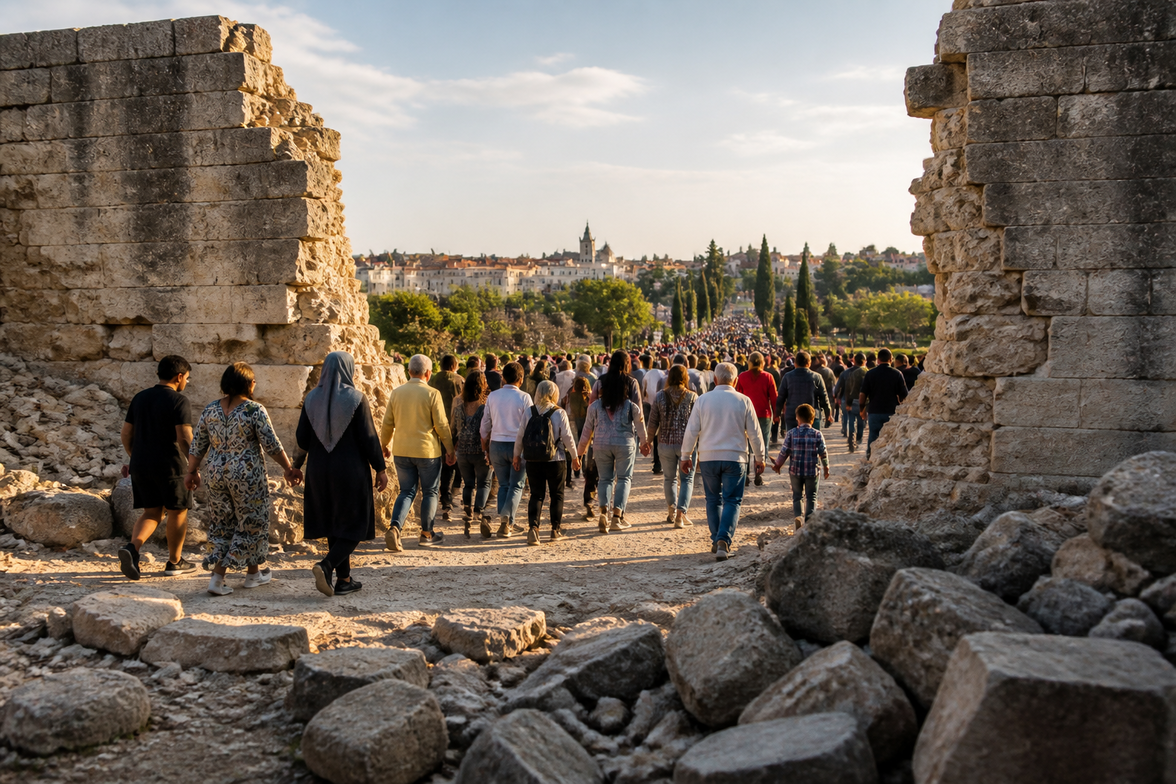
Dismantling Walls

Reading the Word
From 2 Kings: Naaman, commander of the army of the king of Aram, was a mighty warrior, but he had leprosy. Now the Israelite girl who served his wife said, "If only my lord were with the prophet in Samaria! He would cure him of his leprosy." So Naaman went. Elisha sent a messenger: "Go, wash in the Jordan seven times." Naaman became angry. "Are not Abana and Pharpar better than all the waters of Israel? Could I not wash in them, and be clean?" But his servants spoke to him: "If the prophet had commanded you to do something difficult, would you not have done it? How much more, when he says, 'Wash, and be clean'?" So he went down and immersed himself seven times in the Jordan, and his flesh was restored.
From Psalm 87: "Glorious things are spoken of you, O city of God... Among those who know me I mention Rahab and Babylon; Philistia too, and Tyre, with Ethiopia - 'This one was born there,' they say. And of Zion it shall be said, 'This one and that one were born in it.'"
From Acts: Some believers came down from Judea and said, "Unless you are circumcised according to the custom of Moses, you cannot be saved." Paul and Barnabas had no small dissension and debate with them. Peter stood up and said, "God, who knows the human heart, testified to them by giving them the Holy Spirit, just as he did to us... Why are you putting God to the test by placing on the neck of the disciples a yoke that neither our ancestors nor we have been able to bear?" James said, "My judgment is that we should not trouble those Gentiles who are turning to God."
Reflection
Three stories. One truth: God keeps dismantling the walls we build.
Naaman is a Syrian general, an enemy of Israel, a man of power and pride. The hero of his story is an unnamed Israelite servant girl; kidnapped, enslaved, and yet brave enough to suggest that her enemy might find healing in her homeland. Her faith is larger than his. She sees what he cannot: that God's mercy does not stop at the border.
Naaman nearly misses his healing because it is too simple, too humble, too foreign. He wants grand gestures. He wants to be in control. He wants the waters of Damascus, not the muddy Jordan. His servants, once again the marginalized people speaking truth to power, persuade him. "If he had asked something difficult, would you not have done it?" Sometimes the hardest thing is to accept grace on God's terms rather than our own.
And then Acts 15, the Jerusalem Council. The early church is in crisis. Some want to make Gentiles convert to Judaism first. They want to add requirements to grace. Peter, who once needed a vision to enter a Gentile home, now stands and says: God gave them the Spirit just like us. James, the brother of Jesus, makes the decision: do not trouble them. Do not place on them a yoke we could not bear ourselves.
Psalm 87 sings the result. Zion, the city of God, registers citizens from Babylon and Philistia, from Tyre and Ethiopia. "This one was born there." The foreigner is not merely tolerated. The foreigner is registered as native-born. The outsider is written into the census as family.
This is the heartbeat of the gospel. The servant girl matters as much as the general. The Gentile convert matters as much as the Jewish disciple. The requirement is not conversion to culture but trust in God's mercy. And the Church's job is not to build walls but to announce that the walls are already down through the Cross.
We are the ones who keep wanting to add hoops. Circumcision. Doctrine. The "correct" interpretation or the right church denomination. The right political affiliation. The right language. The right documentation. And God keeps saying: I gave them the Spirit. I healed the Syrian. I registered the Babylonian as a citizen of Zion. Stop troubling My people.
Prayer
O God, you register the foreigner as family. You heal the enemy. You give your Spirit without checking credentials. Forgive us for building walls where you have built bridges. Forgive us for adding requirements to grace, for making the simple complicated, for wanting our own waters instead of the Jordan you offer.
We pray for everyone told they must become something else before they can belong. May they know your mercy has no prerequisites. May they know the waters are ready. May they know they are already registered as citizens of your city. Amen.
For Today
Where are you still demanding that people jump through your hoops before they can belong? And where might you need to let go of your own pride, like Naaman, and accept healing in the humble form God offers?

-
Trinity Parish Presbyterian Church