No Distinction

Reading the Word
From Acts: The young church nearly split over who belonged. Certain teachers insisted, “Unless you are circumcised according to the custom of Moses, you cannot be saved.” After long debate in Jerusalem, Peter stood and told what he had seen among the gentiles: “And God, who knows the human heart, testified to them by giving them the Holy Spirit, just as he did to us, and in cleansing their hearts by faith he has made no distinction between them and us.” Then James settled it: “Therefore I have reached the decision that we should not trouble those gentiles who are turning to God.”
From the Psalms: “Out of the depths I cry to you, O Lord. Lord, hear my voice! Let your ears be attentive to the voice of my supplications! If you, O Lord, should mark iniquities, Lord, who could stand? But there is forgiveness with you, so that you may be revered” (Psalm 130:1–4). And in the complementary track, Psalm 87 imagines God keeping a registry of the holy city in which the old enemies—Egypt, Babylon, Tyre—are counted as native-born.
From 2 Kings: Naaman, a foreign general with a skin disease, comes to Israel expecting a spectacle and is handed a plain instruction instead. It is a captive girl, a trafficked child with no standing at all, who first points him toward healing, and his own servants who talk him out of his rage. Only then: “So he went down and immersed himself seven times in the Jordan, according to the word of the man of God; his flesh was restored like the flesh of a young boy, and he was clean” (2 Kings 5:14).
From Genesis: Joseph’s brothers, hungry and frightened, come back to Egypt with the youngest in tow, bracing for punishment—and are seated at a table and fed.
Reflection
Every one of today’s readings turns on a question the church has never fully stopped asking: who is allowed in, and on what terms? In Jerusalem the answer being pushed was a requirement—a body modified, a code kept, a threshold cleared. Peter’s answer was an observation. He had watched the Spirit arrive among people who had cleared no threshold at all, and he refused to argue theology against what he had seen God actually do. God “has made no distinction between them and us.” That is not a policy the council generously adopted. It is a fact they were slow to catch up to.
Notice how Peter names the cost of getting this wrong. A yoke, he calls it—“a yoke that neither our ancestors nor we have been able to bear.” Religious gatekeeping is rarely presented as cruelty; it is presented as seriousness, as standards. But Peter had felt its weight on his own neck, and he knew what it does to people who are already carrying too much. Whenever the church makes belonging conditional, the people who pay are the ones with the least margin to spare.
Naaman’s story runs the same current through a different channel. Healing comes to him through the least powerful voices in the account—a captive girl and a handful of servants—and it arrives without ceremony, in a muddy river he considered beneath him. The word of God reached the general by traveling up from the bottom of the household. If we want to know where God is speaking in our own towns, that is a good place to look: not at the podium, but among the people who are usually only spoken to.
And Psalm 130 tells us why any of this is possible. The psalmist is not praying from a position of strength; he is praying from the depths—the debts, the diagnoses, the ruptures, the quiet 3 a.m. arithmetic of a household that is not going to make it this month. From down there he says the truest thing in scripture: if God kept a ledger, none of us would be standing. There is forgiveness with you. Grace is not the reward at the end of the qualifying process. It is the ground we were standing on the whole time.
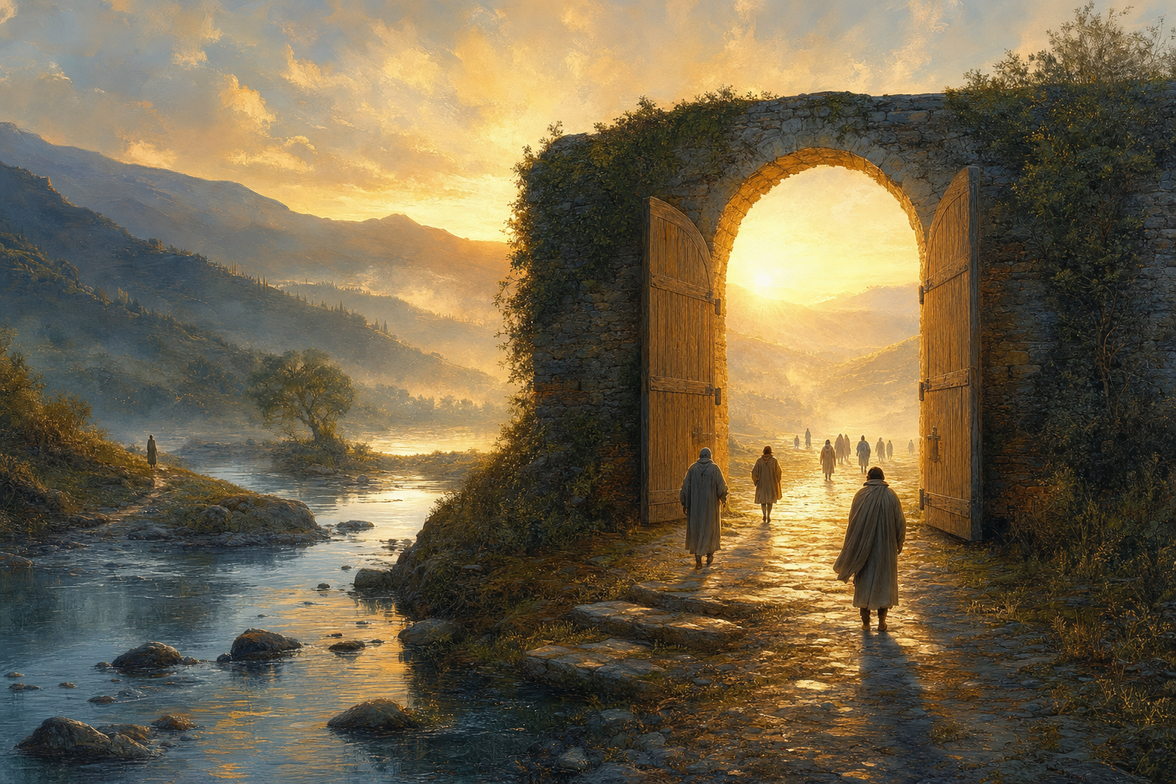
Which is exactly why the psalm ends in waiting rather than in resolution. “My soul waits for the Lord more than those who watch for the morning.” The watchman does not make the sun rise; he simply knows which direction to face. Joseph’s brothers, expecting a reckoning, got a meal. Naaman, expecting a performance, got clean water. The gentile believers, told they were outside, were already full of the Spirit. God keeps being more generous than the systems built in God’s name—and our work is less about defending the door than about noticing it has been opened wider than we thought.
So the practical question today is not whether we believe in inclusive love in the abstract. It is whether, like Peter, we are willing to change our minds in public when we see the Spirit at work in someone we had ruled out—and whether, like Joseph, we are willing to set a table before anyone has finished explaining themselves.
Prayer
God who knows the human heart, we come from the depths and not from the heights. Hear the voice of our supplication. We pray for those doing math they cannot make work—rent, groceries, the medication that costs more than the week can hold. We pray for those living with illness that has narrowed their world, for those waiting on a call that will not come, for those who have been told, in words or in silence, that they do not belong here.
Teach us your habit of making no distinction. Where we have built thresholds, give us the courage to take them down. Where we have mistaken our standards for your holiness, forgive us and turn us around.
Make us watchers for the morning—honest about the dark, and still facing east. Give us grace enough to receive, and grace enough to hand along. Amen.
For Today
Where in your own life have you been carrying a yoke of conditions—something you believe you must clear before you are worthy of love or rest?
Who has been the “captive girl” in your life: a person with little standing whose word turned out to be God’s word to you? Have you thanked them?
Is there someone your circle has quietly ruled out—and what would it look like this week to set a table for them before they have explained themselves?

-
Trinity Parish Presbyterian Church