Passover

Reading the Word
From Exodus: The LORD said to Moses and Aaron in the land of Egypt, "This month shall mark for you the beginning of months... Tell the whole congregation of Israel that on the tenth of this month they shall take a lamb for each household... They shall take some of the blood and put it on the two doorposts and the lintel of the houses in which they eat it... For I will pass through the land of Egypt that night, and I will strike down every firstborn in the land of Egypt, both human beings and animals... The blood shall be a sign for you on the houses where you live: when I see the blood, I will pass over you, and no plague shall destroy you when I strike the land of Egypt. This day shall be a day of remembrance for you."
From Psalm 149: "Praise the LORD! Sing to the LORD a new song, his praise in the assembly of the faithful... Let the high praises of God be in their throats and two-edged swords in their hands, to execute vengeance on the nations and punishment on the peoples, to bind their kings with fetters and their nobles with chains of iron."
From Matthew: Jesus said, "If another member of the church sins against you, go and point out the fault when the two of you are alone. If the member listens to you, you have regained that one. But if you are not listened to, take one or two others along with you... If the member refuses to listen to them, tell it to the church... Truly I tell you, whatever you bind on earth will be bound in heaven, and whatever you loose on earth will be loosed in heaven. Again, truly I tell you, if two of you agree on earth about anything you ask, it will be done for you by my Father in heaven. For where two or three are gathered in my name, I am there among them."
Reflection
Passover is not a private salvation.
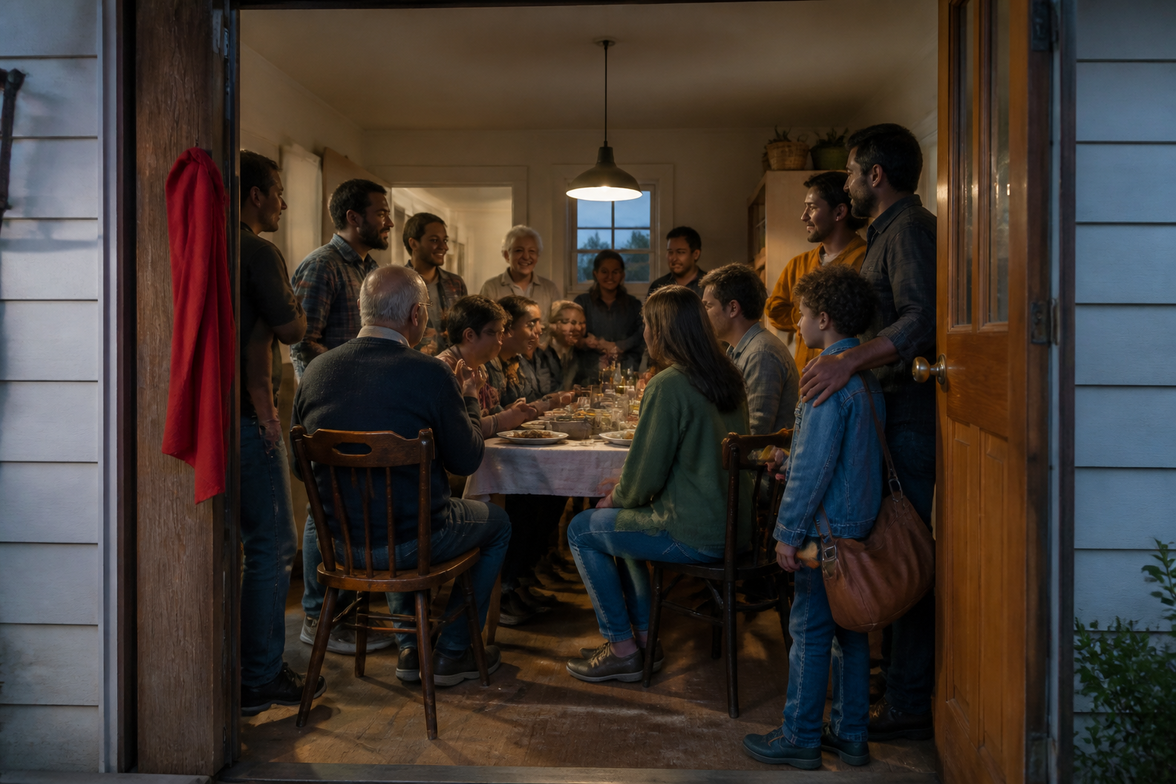
The blood is not on individual hearts. It is on doorposts and lintels - the public thresholds of households gathered together. The lamb is not for one person but for a household, and if a household is too small, they are to join with their neighbor. The feast is communal. The remembrance is corporate. And the judgment that passes over is the judgment of a God who sees the whole system of oppression - the whole house of Pharaoh - and says: this ends tonight.
But notice what the blood does. It does not save because it is magical. It saves because it is a sign. "When I see the blood, I will pass over you." The sign says: these people are marked by solidarity. They have chosen the God of the Hebrews over the gods of Egypt. They have eaten the Passover meal in haste, with their loins girded and their sandals on, ready to move. The blood is the outward mark of an inward readiness to leave everything behind for freedom.
And then in Matthew 18, Jesus gives his community instructions for how to live after the Exodus. The church is not a social club. It is a colony of the kingdom, and kingdoms have accountability. If someone sins against you, go to them alone. If that fails, bring witnesses. If that fails, tell it to the church. This is not gossip. This is not canceling. This is the radical practice of refusing to let broken relationships stay broken. It is binding and loosing...holding people accountable for the sake of liberation.
The two or three gathered are not a quorum for institutional business. They are the minimum number of witnesses required by Jewish law. And Jesus says: even that small gathering, when it is in my name, holds my presence. The same presence that passed over Egypt in judgment is present in the living room where two people try to reconcile.
Psalm 149 holds the frame: the assembly singing a new song, the faithful with praise in their throats and the word of justice in their hands. The binding of kings with chains is God's work, not ours. But the praise of the faithful is the breath that keeps the community alive while God does what only God can do.
This is the vision of Church we need. Not a building where individuals get saved, but a household marked by the blood of the Lamb, which is to say, marked by solidarity with the oppressed, readiness to move when freedom calls, and the stubborn practice of reconciliation. We gather to remember. We gather to confront. We gather because the presence of Christ is not in the architecture but in the relationships.
And the Passover still happens. Every time we refuse Pharaoh's economy. Every time we share our lamb with a neighbor whose household is too small. Every time we say "I am there among you" to the ones gathered in my name.
Prayer
O God, you passed over Egypt and made a new beginning. Mark our doorposts not with magic but with solidarity. Make us ready to leave what enslaves us.
Teach us to gather as you taught: face to face, witness by witness, loving enough to confront, brave enough to reconcile.
May the two or three in the living room, at the kitchen table, in the protest line, or in the workplace, know that you are there.
And may our praise be the breath that keeps your people alive until every Pharaoh falls. Amen.
For Today
What is enslaving you that you need to be ready to leave? Who do you need to approach alone, for the sake of reconciliation? And where are two or three gathering in Jesus' name, and can you join them?
-
Trinity Parish Presbyterian Church