Reluctant Hands

Reading the Word
From Exodus: Moses answered, "But suppose they do not believe me or listen to me, but say, 'The LORD did not appear to you.'" Then the LORD said to him, "What is that in your hand?" "A staff," he said. "Throw it on the ground." So he threw it, and it became a snake; and Moses drew back from it. Then the LORD said, "Reach out your hand and take it by the tail" - so he reached out his hand and grasped it, and it became a staff again. The LORD said to him, "If they will not believe you, pour water on the ground, and it shall become blood." And the LORD said, "If they will not believe even these two signs, take some water from the Nile and pour it upon the dry ground; the water that you take from the Nile will become blood on the dry ground."
From Psalm 105: "O give thanks to the LORD... Sing to him... tell of all his wonderful works... He sent his servant Moses, and Aaron whom he had chosen... Praise the LORD!"
From Matthew: When Jesus entered Peter's house, he saw his mother-in-law lying in bed with a fever; he touched her hand, and the fever left her, and she got up and began to serve him. That evening they brought to him many who were demon-possessed; and he cast out the spirits with a word, and cured all who were sick. This was to fulfill what had been spoken through the prophet Isaiah, "He took our infirmities and bore our diseases."
Reflection
Moses is terrified of looking foolish.
He has heard the call. He has seen the burning bush. But now, in the cold light of day, he imagines standing before the elders of Israel with nothing but a story. "Suppose they do not believe me?" It is the anxiety of every person who has ever felt called to speak up, to lead, to act for justice, and feared they would be laughed out of the room.
And God's response is unexpected. God does not say, "Have more faith." God does not rebuke Moses for his doubt. God asks: "What is that in your hand?" A staff. An ordinary stick. A shepherd's tool, weathered and plain. God takes the thing Moses already carries and makes it extraordinary.
But notice: Moses draws back from the snake. He is still afraid. God does not say, "Be brave." God says, "Reach out your hand and take it by the tail." The sign is given to a man who flinches. The power is entrusted to hands that tremble.
God does not wait for us to become courageous, articulate, or fully healed before God uses us. God takes our ordinary tools, our degrees, our credentials, our kitchen tables, our stammering voices, and makes them signs of liberation. The staff becomes a snake and then a staff again. The thing that frightens us becomes the very proof that God is with us.
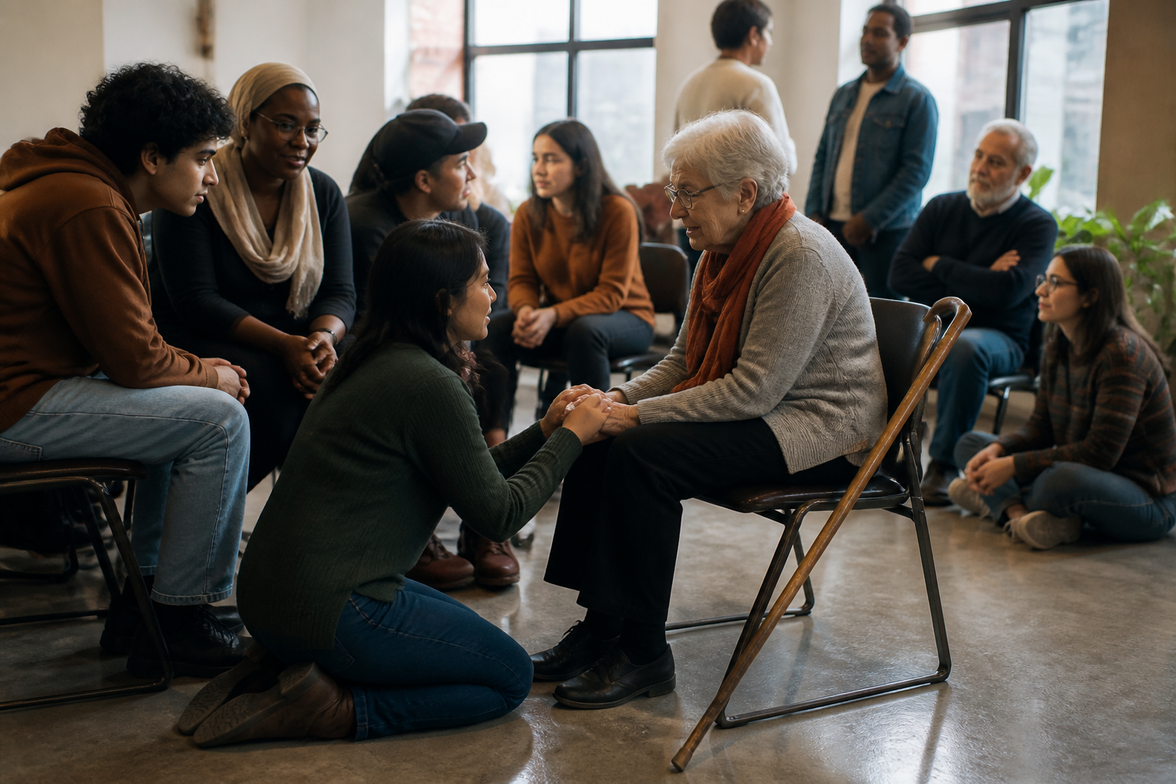
And then Matthew. Jesus enters Peter's house and touches a woman's hand. She is sick with fever, confined to bed, invisible in the way that illness so often makes people invisible. He touches her; a simple, human gesture that crosses boundaries of gender and social custom. And she rises. She serves. The Greek word is diakoneo, the same word used for the ministry of the church. Healing is not just the removal of symptoms. It is restoration to community, to purpose, to the dignity of serving others.
That evening, the whole town comes. They bring the demon-possessed, the sick, the ones whom society has cast to the margins. Jesus heals them. Matthew says this fulfills Isaiah: "He took our infirmities and bore our diseases." The one who bears our suffering is not a distant God but the one who touches us, who draws back like Moses and reaches out anyway, who uses human hands to do divine work.
The psalmist tells us to sing of God's wonderful works. But the wonderful work is not only the dramatic sign. It is also the ordinary staff. It is also the touch of a hand. It is also the reluctant prophet who said "What if they do not believe me?" and went anyway.
Prayer
O God, you do not wait for our courage before you call us. What is in our hand? A pen, a phone, a stethoscope, a spatula, a word we are afraid to speak.
Take it. Make it a sign. Even when we draw back, even when we tremble, reach out through our reluctant hands.
We pray for everyone who feels invisible in their illness, their exhaustion, their doubt.
Touch them. Raise them up into the dignity of service, into the joy of community.
Praise God, who uses shepherd's staffs and trembling prophets, who bears our diseases and makes us whole. Amen.
For Today
What is in your hand that God might use? Where are you drawing back from a call because you fear you will not be believed? And who in your life needs the simple, healing touch of human presence?

-
Trinity Parish Presbyterian Church