Shelter in the Smallest Seed

Reading the Word
Psalm 65:8-13
The poet sees creation as a choir. Dawn and evening shout for joy. The wilderness, usually a place of fear and scarcity, overflows with abundance. The hills are not merely green; they are clothed with gladness. This is not a scene of domination or extraction. It is a picture of mutual flourishing: God waters the earth, the earth responds with grain and gladness, and the community joins the song. The psalmist knows that abundance is not automatic. It is the result of God's attentive, nurturing care. Every furrow is drenched, every ridge is softened, every crop is blessed. And creation itself becomes witness to the covenant faithfulness of God.
Genesis 46:2-47:12
God speaks to Jacob in the night: "Do not be afraid to go down to Egypt, for I will make you a great nation there. I will go down with you, and I will surely bring you back." The promise does not depend on staying in one place. It travels. Jacob migrates with his whole household, seventy souls, a mixed multitude, a family of many nations already. In Egypt, Joseph meets his father and weeps on his neck. Then he introduces his family to Pharaoh, and the king gives them the best of the land, the land of Goshen. This is the story of a refugee family finding welcome in a foreign land. It is the story of a son who has risen to power using his position to shelter his kin. It is the story of God keeping the covenant promise, especially in the diaspora. The family that was promised a land now becomes a people in another land, and God is with them.
Mark 4:30-34
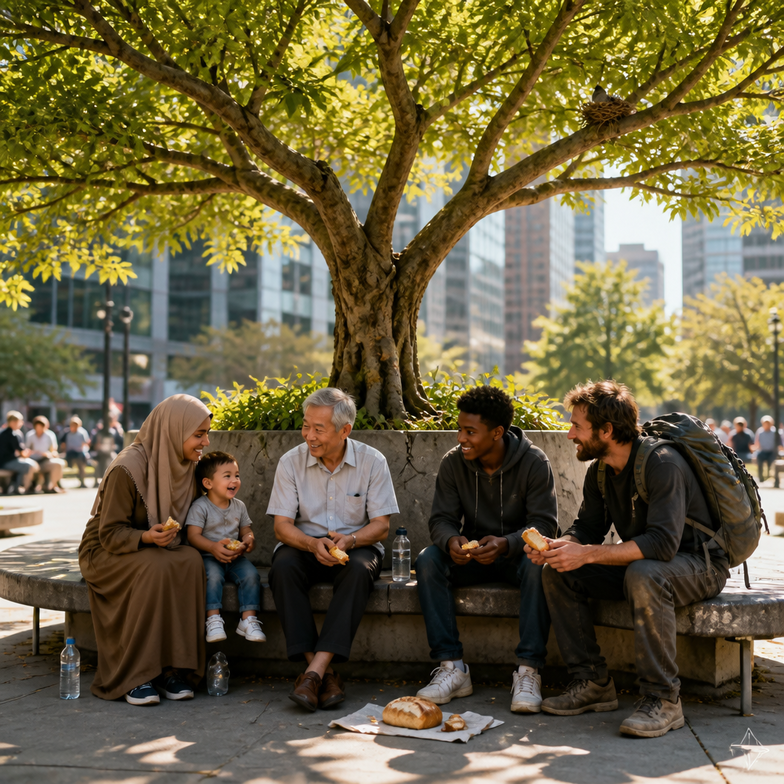
Jesus asks: What is the kingdom of God like? It is like a mustard seed, the smallest of all seeds, which grows into the greatest of all garden plants. The birds of the air nest in its shade. This is the parable that subverts every expectation of empire. The kingdom does not arrive with the force of a cedar or the fortification of a city. It arrives as something almost invisible, something that can be held in the palm of a hand, and then it grows into shelter for the vulnerable. The birds of the air, unclean, uncontrolled, outside the boundaries of the temple, find their home in its branches. The kingdom is not a walled fortress. It is a tree with open branches.
Reflection
What do a singing valley, a refugee family, and a backyard weed have in common?
They are all God's answer to the question of where we find shelter.
The psalmist teaches us that abundance is not found only in cultivated gardens. The wilderness overflows. The grasslands that were supposed to be barren become the place where streams run. This is the geography of grace: God meets us not only in the places we have prepared but in the places we have feared.
Genesis tells us that the covenant family is a migrant family. Jacob does not stay in the land of his fathers. He goes down to Egypt because famine and family need compel him. And God says, "I will go down with you." This is the God who is not bound by borders. The family settles in Goshen, the best of the land, because Joseph has the courage to leverage his power for kinship. Joseph is the dreamer who became an administrator, and instead of using his power to assimilate or forget, he uses it to make room. This is the ancient blueprint for what solidarity looks like: those who have access to the halls of power opening doors for those who have none.
And Jesus, looking at the small, unimpressive, everyday things of his world, says: That is the kingdom. The mustard seed is not a noble plant. It is a weed, a fast-growing, invasive, uncontrollable thing that farmers sometimes resented. But Jesus lifts it up as the very image of God's reign. It starts so small it is nearly invisible. It grows so large that birds, those outsiders, those wanderers, those creatures without a home, find shade in its branches. This is the kingdom: not a fortress for the worthy, but a shrub for the birds.
The connection is profound. The wilderness that overflows in Psalm 65 is the same wilderness that Jacob crosses. The seed that becomes a sheltering tree is the same seed of promise that God planted in Abraham, nourished in Isaac, and is now growing in Egypt. The kingdom is always on the move, always surprising, always making room for the ones who have no room.
For us today, this is an invitation to rethink where we look for God.
We often look for the kingdom in the grand and the impressive, in the megachurch, the viral movement, the powerful institution. But Jesus says: look for the smallest seed. Look for the weed growing through the crack. Look for the place where the outsider is finding shade.
We often think that faithfulness means staying put, guarding the land, keeping the borders. But the covenant God says: I will go with you to Egypt. The family of faith is a migrant family. The people of God are always being called across borders, into foreign lands, to be a blessing there.
We often measure abundance by what we can control. But the psalmist says: the valley is singing, and we do not conduct the choir. The hills are clothed with gladness, and we do not sew the garments. The wilderness overflows, and we do not dig the stream.
So where are you today?
Are you in the wilderness, believing it must be empty? Look again. The streams are running.
Are you on the road to an unfamiliar place, afraid of what you will find? God is going with you. The promise travels.
Are you tending a seed so small that no one else notices? Keep tending. The branches will shelter more than you can imagine.
Are you a bird without a nest, watching from the outside? The tree is growing. There is room for you.
The kingdom of God is not a fortress. It is a mustard seed. It is a refugee family. It is a wilderness valley singing in the rain. And it is growing, even now, to make room for us all.
Prayer
God of the wilderness and the wandering road, you are not bound by our borders or impressed by our size. We praise you for the wilderness that overflows, for the God who says, "I will go down with you," and for the mustard seed that grows into shelter for the birds.
We confess that we have looked for the kingdom in the wrong places: greatness instead of grace, fortresses instead of branches. Forgive us and redirect us.
Make us a people who plant small seeds with great hope, who welcome the wandering family, who share the shade, and trust that abundance is your gift.
We are crossing borders. We are holding seeds in our hands. And you are with us. Amen.

-
Trinity Parish Presbyterian Church