The Danger of Arriving

Reading the Word
Psalm 78:1-8, 17-29
This is a teaching psalm, a communal memory passed down like a family story that includes all the hard parts. The poet insists that we must tell the next generation about God's deeds, God's power, and the wonders God has done. But the psalm is shockingly honest: our ancestors were stubborn and rebellious. They tested God in the wilderness. They demanded food, and God provided quail like dust, bread from heaven, water from flinty rock. This is not a history of heroic saints. It is a history of divine persistence. The progressive gift of this psalm is permission to tell the truth, and our ancestors failed, but God remained faithful. We do not need to sanitize our stories to protect the covenant. The covenant is stronger than our failures.
Deuteronomy 8:1-10
Moses warned the people to remember the wilderness. Remember the feet that swelled for forty years. Remember the manna, which you did not know and your ancestors did not know. Remember that God humbled you, tested you, and fed you with something unfamiliar. And then comes the warning: when you arrive in the good land, when your herds multiply and your silver and gold increase, do not forget the LORD your God. Do not say in your heart, "My power and the might of my own hand have gotten me this wealth." This is one of the most important passages for faith: prosperity is not a sign of divine favor, and abundance is spiritually dangerous. The wilderness is where we learn dependence. The Promised Land is where we learn amnesia. The text calls us to remember our vulnerability so that we do not become arrogant in our security.
Romans 1:8-15
Paul writes to the Roman church, a community he has never visited, and his first word is gratitude. Their faith is "reported all over the world." He longs to see them, not to dominate them, but to be mutually encouraged by each other's faith. He is a debtor to everyone: Greeks and non-Greeks, wise and foolish. The gospel is not a private possession distributed by the powerful to the powerless. It is a shared power that creates solidarity across every boundary. And it is for everyone.
Reflection
We live in a culture that tells us to forget the wilderness as soon as we find comfort.
Deuteronomy 8 is a warning against the spiritual amnesia of arrival. It knows exactly what happens when people move from struggle to stability: they begin to believe they earned it. They look at their houses and their bank accounts and their credentials and say, "My power and the might of my own hand have gotten me this." It is one of the most honest descriptions of human psychology in Scripture. Success is not the reward for righteousness. It is a test of memory.
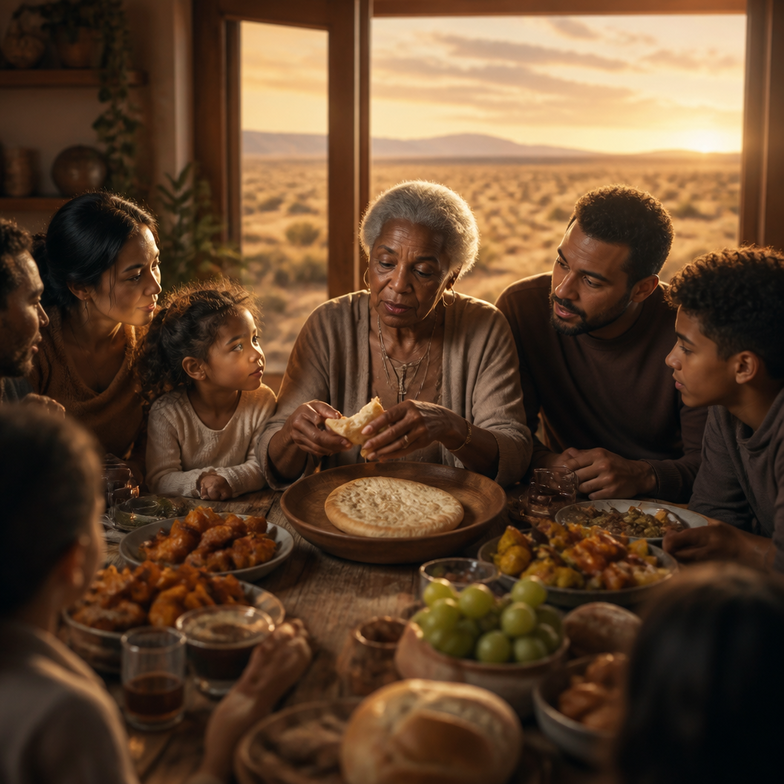
The manna is the antidote to this amnesia. It was strange food. The Israelites had never seen it. Their ancestors had never eaten it. It appeared daily, could not be hoarded, and went bad if you tried to save it. God fed them with enough, not with excess. In the wilderness, they were all equal recipients of daily grace. In the Promised Land, the danger is that some will accumulate while others go hungry, and the accumulators will call it blessing.
Psalm 78 gives us the honesty we need to resist this. The poet refuses to paint the ancestors as heroes. They were rebellious. They were stubborn. They were entitled. And God fed them anyway. This is liberating for us because it means we can tell the truth about our own communities. We can name the rebellion in our history: colonialism, slavery, environmental destruction, exclusion of the marginalized, and still proclaim that God was faithful. The covenant does not depend on our perfection. It depends on God's persistence. And the command to tell the next generation is not a command to lie. It is a command to testify: This is what God did, even when we failed.
We are often tempted either to romanticize our traditions or to reject them entirely. Psalm 78 offers a third way: honest remembrance. We tell our children about the glorious deeds and the stubborn rebellion. We pass on both the miracle and the confession. And in that honesty, we create a community that is humble enough to receive grace.
Romans 1 adds another layer. Paul is famous, but he comes to Rome as a debtor. He wants to be mutually encouraged. The gospel is not a one-way street from the apostle to the congregation. It is a shared power that flows in every direction. This is the economics of the gospel: we need each other. The Roman believers, many of whom were likely slaves, migrants, and poor, have something Paul needs. Their faith is reported around the world. Paul is not ashamed of the gospel because it is powerful enough to create this kind of horizontal community, where the wise and the foolish, the insider and the outsider, are equally obligated to one another.
Put these three texts together and you have a spirituality of remembering dependence.
The wilderness is not a place to escape. It is a classroom where we learn that we do not live by bread alone, but by every word that comes from the mouth of God. The manna is not an inferior substitute for real food. It is the daily evidence that God is enough. And the gospel is not a ticket to prosperity. It is the power that creates a community of equals, where the person with the most credentials comes to learn from the person with the least.
So where are you today?
Are you in the wilderness, eating unfamiliar food, feeling humbled and tested? You are not abandoned. The manna is strange because grace is always strange. Eat it. It will sustain you.
Are you in the good land, surrounded by abundance, tempted to believe you earned your place? Remember the feet that swelled. Remember the flinty rock. Remember that the power to get wealth is a gift, not a wage. And look for the ones who are still in the wilderness.
Are you part of a community that wants to pass on faith to the next generation? Tell them the truth. Tell them the miracles and the failures. Tell them that God is persistent enough to handle both.
Are you waiting for a teacher, a mentor, an expert to bring you the gospel? Paul is coming to learn from you. Your faith is already reported. You have something to give.
The danger is not the wilderness. The danger is forgetting we were ever there. The gospel saves us from amnesia by making us a community of honest memory and mutual need.
Prayer
God of the wilderness and the daily bread, we confess that we are quick to forget. When our feet were swollen, you were our only hope. When our barns are full, we forget your name. Save us from the arrogance of arrival. Teach us to remember the strange grace that kept us alive, and to tell our children an honest story: your miracles and our failures, your persistence and our sin. Make us a community of mutual encouragement, where the gospel creates a table long enough for everyone. We are not ashamed of this good news. We are hungry for it. Feed us again today. Amen.
-
Trinity Parish Presbyterian Church