The God Who Watches Between Us

Reading the Word
Psalm 17:1-7, 15
The psalmist comes before God not with presumption but with a tested heart. "You have tried me; you have tested me." This is the language of refined gold; God's scrutiny is not a threat but a gift. The Reformed tradition has always insisted that true religion begins with God's searching gaze: we come not to perform our righteousness but to be examined by the One who sees truth. The psalmist asks for refuge under the shadow of God's wings, a maternal image that reminds us that divine sovereignty is never distant or cold. It is a shelter. And the final hope is breathtaking: not earthly vindication, not the humiliation of enemies, but to see God's face and be satisfied. In theology, this is the visio Dei, the beatific vision that is the end of all our longing. Every lesser satisfaction, every argument won, every score settled, every privilege secured, is a shadow. The substance is Christ.
Genesis 31:22-42
Jacob flees in secret. Rachel steals the household gods. Laban pursues with relatives and confronts him with accusations. It is family drama at its most dysfunctional: deception, theft, generational trauma, and the reality of two people who don't trust each other. Yet in the middle of this mess, God intervenes: he warns Laban in a dream not to harm Jacob. And Jacob, acknowledging the protection he has received, declares: "If the God of my father, the God of Abraham and the Fear of Isaac, had not been on my side, surely now you would have sent me away empty-handed." Here is the doctrine of providence in narrative form: God is not limited by the moral failings of his people. Jacob is no saint. Rachel is a thief. Laban is exploitative. And yet the covenant promise holds. The two men erect a heap of stones as witness, calling it Mizpah: "May the LORD watch between you and me, when we are absent one from another." Too often sentimentalized, this is actually a covenant of separation between people who cannot fully trust each other but who acknowledge that God sees what they cannot. God is the witness across the boundary.
Romans 1:8-15
Paul writes to the church in Rome, a congregation he has never met, a community of Jew and Gentile, slave and free, known across the empire for their faith. He gives thanks for them. He longs to visit them. He wants to be mutually encouraged by each other's faith. This is the Church in miniature: Paul, the Jewish apostle to the Gentiles, writes to a cosmopolitan Roman congregation to say that the gospel belongs to them all. "I am not ashamed of the gospel, for it is the power of God for salvation to everyone who believes, to the Jew first and also to the Greek." In Reformed theology, this ordering, "to the Jew first," is not a statement of ethnic superiority but a testimony to God's historical faithfulness. The covenant with Abraham is not abolished; it is fulfilled. And the scope is now universal: the same gospel that was the power of God for the descendants of Abraham is the power of God for the Gentile. There is no distinction in the gift.
Reflection
What does it mean to be seen by God?
For the psalmist, it means vindication, not because he is perfect, but because his cause is just and his heart is open to examination. For Jacob, it means survival, not because he is honest, but because the covenant God is faithful. For Paul, it means connection across every boundary that usually divides human beings.
The genius of Romans 1 is that Paul does not come to the Roman church as a celebrity pastor or a theological expert dropping wisdom from above. He comes as a debtor. "I am obligated both to Greeks and non-Greeks, both to the wise and the foolish." He wants to preach the gospel in Rome because he needs them as much as they need him. This is the radical mutuality of the gospel: the apostle who wrote half the New Testament says, "I want to be mutually encouraged by each other's faith." The gospel is not a one-way transaction from the powerful to the powerless. It is a shared life where the Roman believers, many of whom were likely slaves and marginalized, have something Paul needs.
And what they have is faith. Paul thanks God that their faith is "reported all over the world." This is the report of a people who have believed in the face of empire, who have formed community across ethnic lines, who have demonstrated that the power of God is not limited to the corridors of Jerusalem or the synagogues of the diaspora. It is alive in Rome. In the heart of the empire that crucified Jesus, the gospel is bearing fruit.
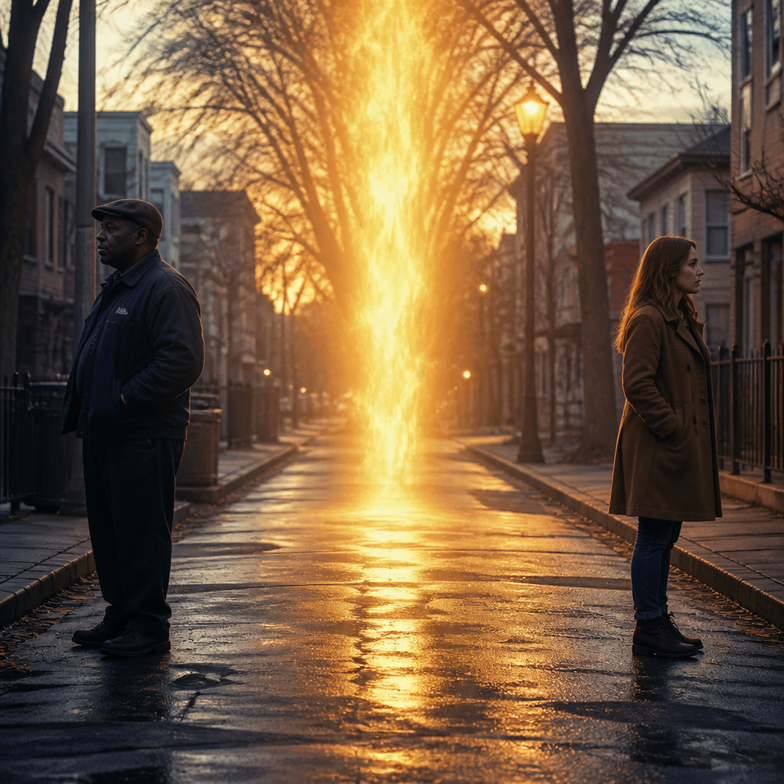
But how does Paul get there? He gets there because he knows the same God who watched between Jacob and Laban. He knows the God who sees what human beings cannot see. The Mizpah covenant was erected between two men who were separated by deceit, fear, and the weight of family trauma. They couldn't fully trust each other. They could not fully reconcile. But they could agree on this: the LORD watches between us when we are absent one from another.
In our polarized world, this is a powerful word. We do not always have the luxury of reconciliation with those who have exploited us, deceived us, or pursued us with hostile intent. Jacob and Laban part ways. The separation is real. But the witness-heap remains: God sees. God judges. God keeps the boundary. This is not a sentimental word about friendship; it is a covenantal word about accountability. When human trust is broken, divine justice remains.
And yet the gospel goes further. Paul does not write to maintain a separation. He writes to create a fellowship. The gospel is the announcement that in Christ, the wall between Jew and Gentile is not merely watched over by God from a distance; it is broken down by the blood of the cross. The God who watched between Jacob and Laban is the same God who gathers the nations into one body. The separation is real, but the gospel is more real.
For us today, this is a call to honesty. We do not have to pretend our relationships are perfect. We do not have to force reconciliation where there is not yet trust. The psalmist can cry out for vindication without shame. Jacob can acknowledge God's protection without excusing his own deceit. Paul can long for fellowship without erasing the very real differences between him and the Roman church. The God who sees the heart is the God who can hold all of this together.
And so we are invited to the same posture: to ask God to test our hearts, to seek refuge in the shadow of divine wings, to trust that God is the witness across every broken boundary, and to believe that the gospel is powerful enough to create mutual encouragement across every line that divides us.
The face we long to see is the face of Christ. The satisfaction we seek is not the winning of the argument but the vision of God. And until that day, we are held in the covenant of grace, watched over by the One who never sleeps, and sent to proclaim a gospel that is powerful enough for the whole world.
Prayer
God who sees the heart and watches between the broken, You have tried us and tested us. You know us. Hide us in the shadow of your wings when we are hemmed in. Be the witness between us when trust has failed. Break down our walls and make us a people of mutual encouragement. Make us honest like Jacob, courageous like the psalmist, and eager like Paul to find one another across the lines that divide. Amen.

-
Trinity Parish Presbyterian Church