The Pattern & The Presence

"Give thanks to the Lord, call on his name; make known among the nations what he has done." (Psalm 105:1)
Meditation
The psalmist opens with a summons to memory. Not vague gratitude, but specific, named remembrance: the covenant with Abraham, confirmed to Isaac, established with Jacob. This is a chain of promise that stretches across generations, a faithfulness that does not depend on human perfection but on divine commitment. "He remembers his covenant forever, the word that he commanded, for a thousand generations" (Psalm 105:8). We are invited to stand in that stream, to remember that we did not make ourselves. We are inheritors.
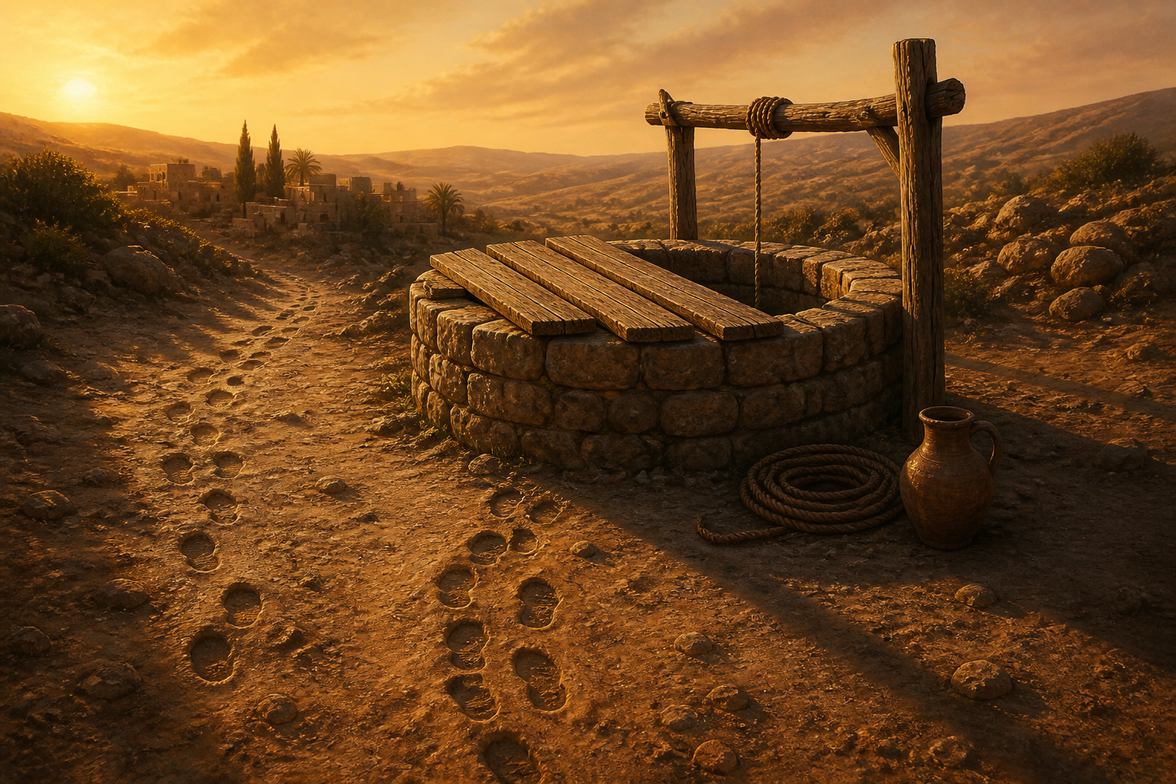
And then we meet Jacob. Not the patriarch in a stained-glass window, but a dusty traveler at a well who has just kissed his cousin and wept aloud. He tells Rachel who he is: "Jacob... Rebekah's son..." and she runs to tell Laban. The next scene is almost comically emotional...Laban runs to meet him, embraces him, kisses him, brings him to his house. Jacob stays a month. The grand covenant of Psalm 105 lands here, in tears at a well, in the awkwardness of explaining your family tree to a stranger, in the messiness of being welcomed into a household that will eventually become a battleground.
This is how God works. The eternal promise unfolds in thirsty travelers, in family reunions, in the ordinary and complicated negotiations of human life. God does not bypass the dust. The covenant is not a theology to be defended; it is a life to be lived.
Which brings us to Stephen, standing before the Sanhedrin with his life on the line. He recounts Israel's history, the tabernacle in the wilderness, made according to the pattern Moses had seen; then Solomon's temple. But then Stephen says something devastating: "Yet the Most High does not dwell in houses made with human hands." He quotes Isaiah. He pushes further: "You stiff-necked people... you are forever opposing the Holy Spirit, just as your ancestors used to do. Which of the prophets did your ancestors not persecute?"
Stephen is not attacking the temple. He is attacking what the temple has become: a container, a controlled space, a place where religious people could believe they had God figured out. The tabernacle was always a pattern, a sketch, a sign, a movable tent pointing toward something greater. The danger is not buildings. The danger is the illusion that we can contain the uncontainable. The danger is turning God's presence into an institution we manage rather than a covenant we surrender to.
Jacob at the well had no temple. He just had a well, a promise, and a future he could not yet see. The psalmist had no building to defend. He simply had memory, gratitude, and the stubborn conviction that God remembers promises even when we forget them. Stephen died because he would not let the religious establishment domesticate the Holy Spirit into something they could control.
For Reflection
Where in your life have you tried to build a "house" for God...a system, a routine, a set of beliefs, that eventually became a cage rather than a tent? What would it look like to let God be mobile again?
Jacob wept at the well. When was the last time you allowed yourself to be surprised by God's presence in an ordinary, inconvenient, human moment? Where is your well right now?
Stephen accused his listeners of resisting the Holy Spirit. Is there a place in your life, a relationship, a conviction, a community, where you might be defending the pattern rather than following the presence?
The psalmist says God "remembered his covenant." You are part of that memory. Who handed the faith to you? Who are you handing it to?
Prayer
O God who moves, who tabernacled in the wilderness and wept at the well, forgive us when we try to build walls where you called us to pitch tents. Forgive us when we defend the pattern and miss the presence. Help us remember your covenant with gratitude, to receive your surprising grace in ordinary moments, and to follow the Holy Spirit even when it unsettles our carefully managed religion. Make us heirs of promise, not guardians of institutions. In the name of the One who is the true temple, Amen.
-
Trinity Parish Presbyterian Church