The Wandering Aramean

Reading the Word
Psalm 78:1-8, 17-29
The poet opens with a teacher's urgency: give ear, incline your hearts, do not hide these things from the children. The story to be told is not sanitized. It includes rebellion, stubbornness, and testing God in the wilderness. And, it includes God's inexplicable mercy. The psalmist insists that the next generation must know both the failure and the provision. That's how faith is transmitted, not through heroic hagiography (the writing of the lives of saints), but through testimony about a God who remains faithful when the people don't.
Deuteronomy 26:1-15
When Israel enters the land and enjoys its abundance, they are to bring the first fruits of the soil and declare: "My father was a wandering Aramean. He went down into Egypt with a few people and lived there and became a great nation, powerful and numerous. But the Egyptians mistreated us..." The liturgy of gratitude is rooted in the memory of vulnerability. The offering is not a tax but a testimony. And it comes with a command: to share with the Levite and the foreigner, the two groups who have no inheritance in the land. The abundance is not a private reward. It is a shared covenant, a table that includes the outsider and the priest alike.
Acts 2:37-47
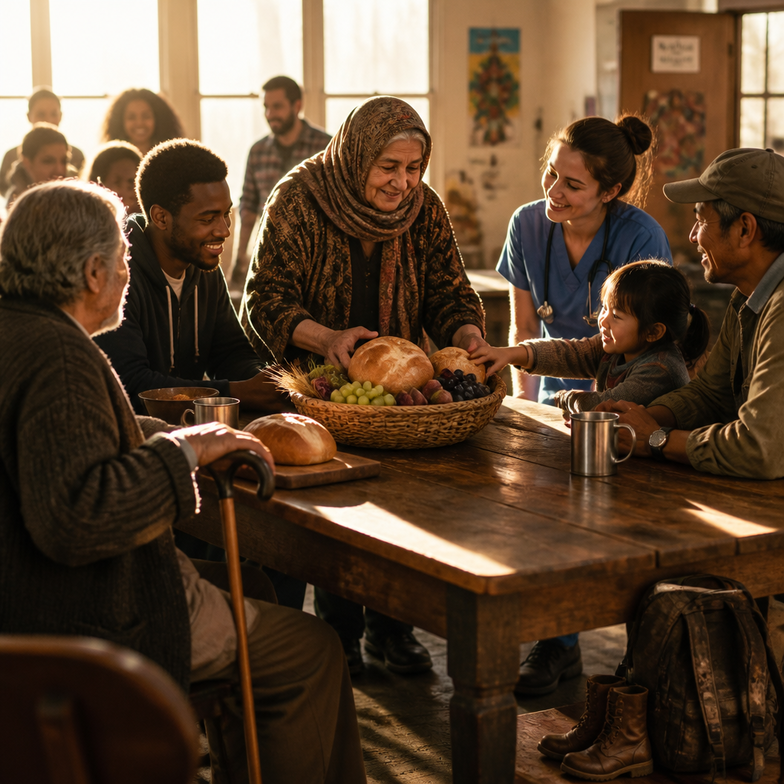
Peter's words cut to the heart; the crowd asks, "What shall we do?" The answer is repentance, baptism, and the gift of the Holy Spirit, for you, for your children, for all who are far off. Then the boundaries explode! Three thousand new believers are added, and the community that forms is radically egalitarian: they share possessions, break bread from house to house, eat with glad and sincere hearts, and sell what they have to give to anyone in need. This is the Promised Land made real, not as a territory to be hoarded, but as a community where no one is in want. The foreigner and the native, the Levite and the laborer, are gathered around the same table.
Reflection
We are a people who forget where we came from.
Deuteronomy 26 gives us the script for the moment of arrival: "My father was a wandering Aramean." Before the basket of first fruits is offered, the history of vulnerability is recited. The liturgy demands that abundance be remembered as rescue, not as entitlement. In a world that often preaches prosperity as proof of virtue, this text is quietly revolutionary. It says: the land you farm, the wealth you hold, the security you enjoy is the result of liberation, not leverage. And the proper response is not self-congratulation but invitation. The Levite gets a share. The foreigner gets a share. The ones who have no land, no status, no inherited right, they belong at the table.
Psalm 78 gives us the courage to tell the truth while we set that table. The poet does not say, "Our ancestors were righteous, and therefore they received manna." He says, "They willfully put God to the test by demanding the food they craved." They were stubborn. They were rebellious. And still the bread came down. This is the memory that sustains honest community: we do not need to pretend we deserve what we have. We need to testify that we have been fed by grace alone. The children who hear this story will not grow up thinking faith is about moral perfection. They will grow up knowing it is about divine persistence.
And then Acts 2 shows us what happens when this memory becomes communal practice. The Church should not hoard its spiritual experience. It breaks it open. The Spirit falls on the marginalized and the foreigner. In the early church, the wealthy sold their property so that the poor would not be in need. The breaking of bread is not a private ritual but a daily rhythm of shared life. This is the first fruits offering in motion: everything belongs to God, so everything is shared.
There is a powerful connection between the manna in the wilderness and the bread in the upper room. The manna could not be hoarded. It spoiled if you tried to save it. The early church took this logic and applied it to property: if you cling to it, it rots. If you share it, it nourishes. The wandering Aramean becomes the wandering church, a community of pilgrims who know that their true homeland is not a plot of land but a fellowship where no one is excluded.
For us today, this is a call to remember, to testify, and to open the table.
If you are in a season of abundance, Deuteronomy 26 is your warning: do not let gratitude become arrogance. Bring the first fruits. Tell the story of the wandering Aramean. And look for those with no inheritance in your system. The foreigner. The worker without a safety net. The one whose labor makes your comfort possible but who never gets invited to the feast. The text says share with them. Not as charity. As covenant.
If you are raising the next generation, Psalm 78 is your permission: tell them the truth. Tell them about the rebellion. Tell them about the stubbornness. And tell them about the bread that came down anyway. The story is not about how good we were. It is about how faithful God is. That honesty will form children who can handle failure, who can confess, and who can receive grace without performing.
If you are part of a community of faith, Acts 2 is your vision: break the bread daily. Share what you have. Let the Spirit fall on the people you did not expect. Do not let your church become a gathering of the already secure. Let it become a fellowship of the wandering, the freed, the fed, and the feeding.
The wandering Aramean is not just Israel's ancestor. He is ours. We are all people who came from somewhere else, who were liberated by a power we did not earn, who are fed by bread we did not bake. And the only faithful response is to set the table, open the door, and invite the stranger to eat.
Prayer
God of the wandering Aramean and the daily bread, we confess that we are quick to forget. We forget the vulnerability of our ancestors. We forget the rebellion that was fed by grace. We forget that our abundance is not our achievement.
Remind us. Tell the story through us. Make us honest enough to confess our failures, and grateful enough to share our first fruits.
Give us the courage of the psalmist, to teach our children that your faithfulness is stronger than our sin. Give us the generosity of the pilgrim, to set a table for the foreigner and the Levite, for the one with no inheritance and the one with no home.
Make us the Pentecost community: breaking bread with glad hearts, sharing what we have so that no one is in need, and welcoming the Spirit to fall on the people we least expect. Amen.

-
Trinity Parish Presbyterian Church