Vindication, Welcome, and Contentment

Reading the Word
Psalm 17:1-7, 15
The psalmist cries out for vindication not from a place of arrogance but from a plea of integrity: "Test me, LORD, and try me, examine my heart and my mind." It is a prayer from someone who feels hemmed in by enemies, watched by the wicked, surrounded by those who speak arrogantly. And yet the hope is not in revenge but in beholding God's face. "As for me, I will be vindicated and will see your face; when I awake, I will be satisfied with seeing your likeness." The deepest longing is not for victory over enemies but for the satisfaction of being seen by God. In a world that often renders people invisible, this psalm insists that God sees the heart, hears the cry, and will bring justice.
Isaiah 14:1-2
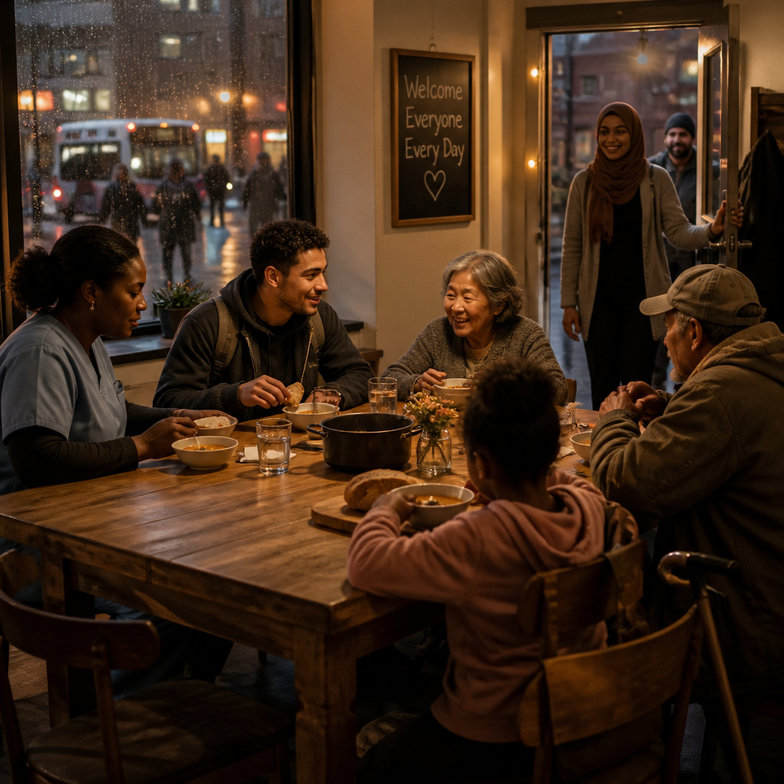
The prophet speaks of a reversal: the LORD will have compassion on Jacob and choose Israel again. The exiles will return, and strangers will join them, attaching themselves to the house of Jacob. The people who were oppressed will possess the nations. This is not a vision of ethnic supremacy but of a widened community: the outsiders becoming part of the family. The oppressed become the welcoming. The ones who were strangers in a foreign land now have space to welcome others. The text imagines a world where the circle keeps expanding, where compassion begets inclusion, where healing leads to hospitality.
Philippians 4:10-15
Paul writes from prison, not to complain but to give thanks. The Philippians have sent him help, and he is genuinely grateful. But he also says something remarkable: "I have learned to be content whatever the circumstances. I know what it is to be in need, and I know what it is to have plenty. I have learned the secret of being content in any and every situation, whether well fed or hungry, whether living in plenty or in want." The secret is not stoicism. It is trust in the One who strengthens him. And the gift from the Philippians is not charity; it is partnership. They share with him in his troubles. This is the economy of the gospel: mutual support, contentment that is not dependent on circumstances, and community that sustains its members across distance and difficulty.
Reflection
We live in a culture that tells us to hustle for our worth, to build our brand, to prove ourselves against competitors. The psalmist shows us another path: asking God to test the heart, not the resume. When we feel surrounded by arrogance, by systems that crush, by voices that say we do not matter, the psalmist's prayer is our own: "Keep me as the apple of your eye; hide me in the shadow of your wings." It is not weakness to ask for protection. It is wisdom to know that we need shelter. And the ultimate hope is not that we will win the argument but that we will see God face to face and find there the satisfaction that every achievement, every accolade, and every revenge could never provide.
Isaiah widens the lens. The return from exile is not a private victory; it is a public demonstration of God's compassion. And it creates a new kind of community: the formerly oppressed now make room for the stranger. In a world that is often cruel to migrants and suspicious of outsiders, this text is an act of holy imagination. It says that the healed community is the welcoming community. The ones who have known what it means to be strangers are the ones best positioned to extend the hand of fellowship. This is the gospel logic: we welcome because we were welcomed. We choose inclusion because we know what it is to be excluded. The nations do not possess Israel; Israel welcomes the nations, and in the welcome, all find a home.
And then Paul, from prison, speaks the quiet word of contentment. This is not a call to passivity. It is the fruit of trust. Paul is not saying that injustice does not matter, that need is not real, or that the Philippians should stop sending support. He is saying that his inner peace is not held hostage by his outer circumstances. He has learned a secret. The Greek word for content is related to self-sufficiency, but for Paul, the sufficiency is not in himself. It is in the One who strengthens him. He can receive the gift with gratitude because he is not desperate for it. He can celebrate the partnership because he trusts that his life is held in a larger story.
What ties these texts together is a pattern of seeing and being seen. God sees the psalmist's heart. The exiled community sees the strangers and welcomes them. Paul sees the Philippians' gift as partnership, not as a transaction. And in all of it, the invitation is to find our satisfaction not in dominating others but in beholding God, in welcoming the outsider, and in trusting that our needs are met within the Body of Christ.
So where are you today?
Are you feeling hemmed in, unheard, surrounded by voices that diminish you? God sees your heart. Hide in the shadow of his wings.
Are you part of a community that has found healing, and are you tempted to build walls to keep others out? The healed community is the welcoming community. There is room.
Are you anxious about what you lack, measuring your life by what you do not have? The secret of contentment is trust. You are held.
Are you in a position to share, to partner, to support someone who is struggling? Do it. The gospel is an economy of mutual care.
Vindication does not come from crushing enemies. It comes from knowing we are seen by God. Welcome does not come from building a fortress. It comes from remembering that we were strangers. Contentment does not come from having everything. It comes from trusting the One who holds everything.
Prayer
God who sees the heart and welcomes the stranger, when we are surrounded by voices that diminish us, hide us in the shadow of your wings. Let us wake to see your face and find our satisfaction there. When we have known exile, make us healers who welcome outsiders. When we have found shelter, let us build longer tables, not higher walls.
Teach us the secret of contentment, not the denial of need, but the trust that you hold us. Make us partners in one another's troubles, sharing what we have with gratitude and grace. Amen.

-
Trinity Parish Presbyterian Church